
5 pillars of engagement
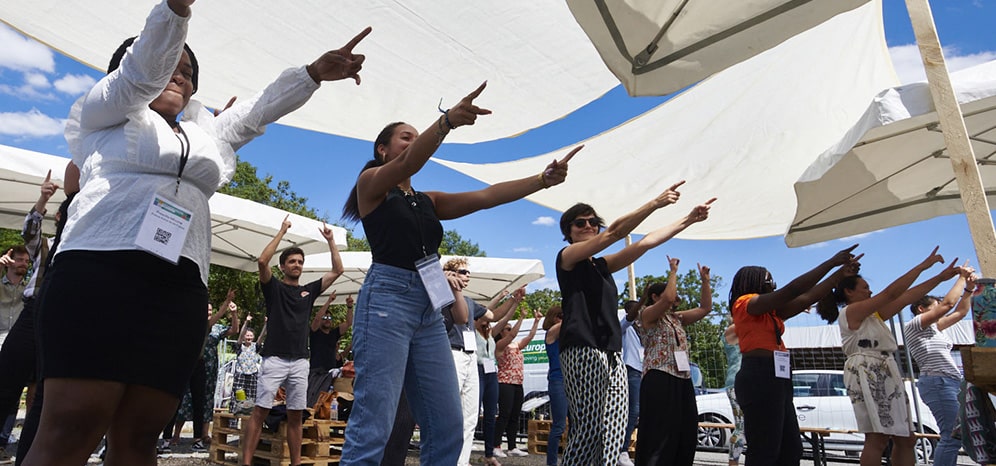
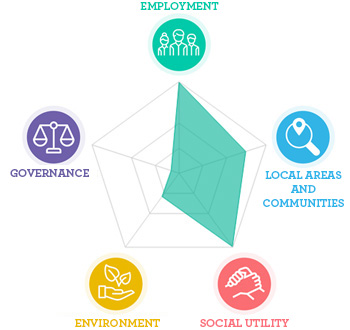
Commitment is in France Active’s DNA. It is the foundation that nourishes our associative mission. It is the thread that connects our employees and volunteers to the enterprises we support. This commitment is put into practice in very concrete ways and is structured around 5 pillars that place people and the future of our planet at the heart of every action: employment, social utility, local communities, environment, and governance.
The France Active “Commitment Index”
Through these five pillars, we define what it means to do business differently—that is, in a way that is sustainable over the long term and takes into account personal, societal, and environmental balances.
During discussions with entrepreneurs, these pillars enable France Active’s teams to evaluate each project and accelerate its progress.
Modelling these elements serves as a “commitment index” that identifies the project’s strengths, as well as the priority levers to amplify its impact.
These five dimensions are the key links in the journey of mutual engagement that connects us to committed entrepreneurs and our partners.
Note: These five pillars of engagement align with the Sustainable Development Goals (SDGs) defined by the UN.
Employment
Does the project create jobs accessible to all?
- Provide access to employment for people who are excluded from the labour market
- Create or preserve quality jobs
Governance
Does the project establish a democratic and balanced model?
- Make the enterprise a democratic and equitable space
- Share profits, distribute wealth more equitably, and promote a collective vision
Local areas and communities
Does the project enhance its local area?
- Address the challenges facing local areas (disadvantaged districts, rural areas)
- Make the most of local resources
Environment
Does the project contribute to the ecological transition?
- Design models that are resource-efficient and promote solidarity
- Develop sustainable models aimed at reducing negative environmental impacts
Social utility
Does the project strengthen social ties and promote access to essential services?
- Promote inclusion and preserve social cohesion
- Facilitate access to essential services, particularly for the most vulnerable populations
Our commitment in action
Employment
At France Active:
- We promote the sustainable inclusion of people who are excluded from the job market and who face difficulties accessing financing.
- We provide funding and support to businesses whose mission is to help people return to work (work integration enterprises, adapted workplaces, etc.),
- We support initiatives aimed at preserving quality jobs and improving the employability of people in precarious situations.
France Active does not invest in activities that result in the loss of local jobs (except in the case of a company in financial difficulty, when the intervention is aimed at ensuring the business’s long-term viability).

Diana Bouzid, who grew up in a priority neighbourhood, opened the restaurant El Inca in Saint-Étienne. « France Active believed in my project and gave me the means to make it a reality. Today, I’m proud to lead a team of seven women in a restaurant that’s running at full capacity. »
Local areas and communities
At France Active:
- We fund locally rooted businesses that meet the needs of their communities in a tailored and accessible way. We pay particular attention to priority areas, such as rural or disadvantaged districts.
- We support initiatives that make the most of local resources and foster collaboration among local stakeholders. The goal? To revitalize communities for the benefit of their residents.
- France Active excludes funding for projects that result in the relocation outside of France of activities that could be maintained within the country.

In the small village of Engins, with a population of just 460 people and without any local businesses for over thirty years, an unconventional space is breathing new life into the community and fostering social connections: La Grange à Gaby, a “third place” that combines a game café, a cultural bistro, a stopover inn, creative cuisine, a convenience store, and live performances. “It’s sort of the culmination of what we’ve always wanted: to create a gathering place that highlights culture, inclusion, and diversity,” explains Pascal Buis, one of the project leaders.
Social utility
At France Active:
- We support projects that strengthen social ties and reduce inequalities.
- We encourage the creation of services for the most vulnerable people to combat all forms of exclusion (social, economic, cultural, etc.) and discrimination.
France Active does not work with organizations involved in controversial activities, such as the arms trade (conventional and non-conventional), pornography, or drug-related activities.
Hélène Vaudon is the executive director of CIDIL, a job-integration workshop located in Charente that serves as a learning environment where job seekers can receive training in construction and organic vegetable farming.
“For 30 years now, France Active has been there to help us invest in and professionalize the work of this job-integration workshop and ensure its long-term viability.”
Environment
At France Active:
- We prioritize enterprises that place sustainability at the heart of their business model.
- We support all activities that seek to reduce their negative impacts on the environment (waste management, short supply chains, circular economy, biodiversity conservation, etc.).
France Active is committed to not funding projects involved in serious environmental damage, particularly regarding biodiversity, toxic waste management, or activities related to fossil fuels.

Joanne Boachon founded Minéka with the goal of saving construction materials that could be reused from the dump. She and her team give them a second life by offering them to businesses, organizations, and individuals. France Active financed the initial working capital needs and offered her the opportunity to join a DLA (local support program). “This support was key, because it allowed us to get organized and pay our first salaries.”
Governance
At France Active:
- The entrepreneurs we support are committed to democratizing the management of their businesses: collective decision-making, transparency, profit-sharing, etc.
- Profitability targets are set to ensure a balance between the organization’s long-term sustainability, fair compensation for employees, and increased engagement.
- We train project leaders in implementing more cooperative governance models (SCOP, SCIC, etc.) that promote the empowerment of the women and men involved.
France Active excludes enterprises with unbalanced or opaque governance practices, particularly in cases of excessive compensation levels, the absence of strategic steering bodies, or involvement in tax evasion practices.

In the Pyrenees, a collective of farmers took on a bold challenge: pooling their resources to create a cannery and a store for their meat. At the heart of the project were five producers united by a single vision: to raise, process, and sell their products through short supply chains. According to Maud Simian, coordinator of the Scic du Barétous: “Choosing the Cooperative Society of Collective Interest (Scic) structure allowed us to reflect the collective nature of the project and our desire to include the town hall in the structure.”
France Active’s commitment also extends to
>Citizens
Through solidarity-based savings that support the financing of projects with social and environmental benefits.
>With investors
By encouraging investments that help fund projects with a positive impact on communities, regions, and the environment.